COMPOSE: Hypergraph Cover Optimization for Multi-view 3D Human Pose Estimation
Tony Danjun Wang, Tolga Birdal, Nassir Navab, Lennart Bastian
Neural Information Processing Systems (NeurIPS), 2026
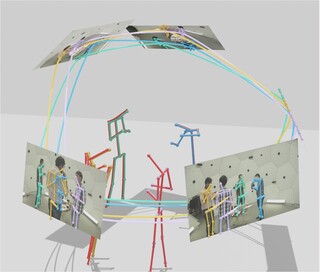
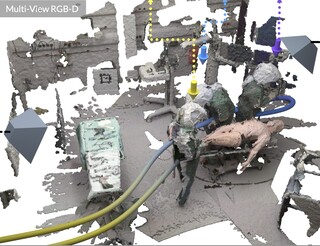
We reformulate multi-view 3D pose estimation as a hypergraph partitioning problem, introducing efficient geometric pruning to achieve up to 23% improvement in average precision over previous optimization-based methods.
MICCAI
TopoOR: A Unified Topological Scene Representation for the Operating Room
Tony Danjun Wang, Ka Young Kim, Tolga Birdal, Nassir Navab, Lennart Bastian
Medical Image Computing and Computer Assisted Intervention (MICCAI) - Early Accept (Top 9%) · Young Scientist Award, 2026
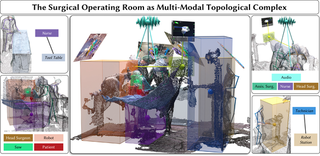
We model the surgical operating room as a multi-modal topological complex, introducing TopoOR, a unified scene representation that captures higher-order relationships between staff, instruments, and patient across imaging, audio, and spatial modalities for holistic surgical scene understanding.
Preprint
Topological Neural Operators
Lennart Bastian, Samuel Leventhal, Mustafa Hajij, Tolga Birdal
Preprint, 2026
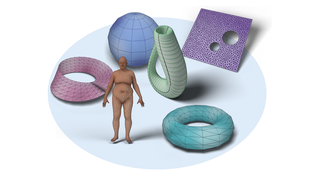
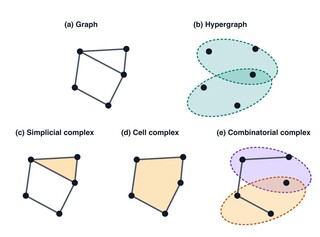
We introduce Topological Neural Operators (TNOs), a framework for operator learning on cell complexes that lifts neural operators from points and edges to topological domains. Using Discrete Exterior Calculus, TNOs decouple where information flows (fixed topological operators) from how it is transformed (learned), and the hierarchical variant (HTNOs) propagates long-range, topology-dependent information — improving accuracy across PDE benchmarks including irregular-geometry flows.
ICML
DisPOSE: Projected Polystochastic Diffusion for Self-Supervised 3D Multi-View Human Pose Estimation
Tony Danjun Wang, Tolga Birdal, Nassir Navab, Lennart Bastian
International Conference on Machine Learning (ICML), 2026
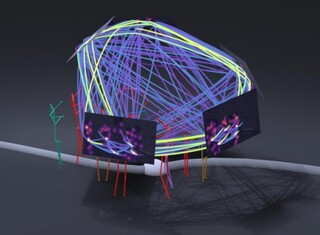
We introduce DisPOSE, a self-supervised framework that approximates the discrete multi-view person-assignment problem as a generative diffusion process over polystochastic tensors, using differentiable Sinkhorn projections to guide solutions toward valid assignments from 2D image priors — retaining 99% of its performance with only 10% of the pseudo-labels and remaining nearly agnostic to camera arrangement.
ICML
Collapsed Effective Operators for Higher-order Structures
Maximilian Krahn*, Lennart Bastian*, Vikas Garg, Björn Schuller, Tolga Birdal
International Conference on Machine Learning (ICML), 2026
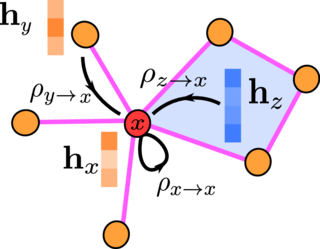
We introduce Collapsed Effective Operators, which condense higher-order degrees of freedom into a single vertex-level operator via Schur complementation of a graded Laplacian. The resulting operator encodes long-range, topology-mediated interactions, preserves positive semi-definiteness with a strict spectral bound relative to the Hodge Laplacian, and improves spectral clustering, signal smoothing, and topological positional encodings in neural networks.
CVPRW
DeepShapeMatchingKit: Accelerated Functional Map Solver and Shape Matching Pipelines Revisited
Yizheng Xie, Lennart Bastian, Congyue Deng, Thomas W. Mitchel, Maolin Gao, Daniel Cremers
CVPR Image Matching Workshop (IMW) 2026, 2026
Deep functional maps underpin non-rigid 3D shape matching but rely on solvers that process spectral systems serially, a bottleneck at higher resolution. We introduce a vectorized reformulation that solves them in a single kernel call for up to a 33x speedup with identical results, document a previously unnoticed divergence in DiffusionNet’s spatial-gradient features, and revisit overlap metrics for partial-to-partial matching. These improvements ship in DeepShapeMatchingKit, an open-source toolkit that standardizes training, evaluation, and data pipelines for common deep shape matching methods.
Eurographics STAR
Non-Rigid 3D Shape Correspondences: From Foundations to Open Challenges and Opportunities
Aleksei Zhuravlev*, Lennart Bastian*, Dongliang Cao, Nafie El Amrani, Paul Roetzer, Viktoria Ehm, Riccardo Marin, Hiroki Nishizawa, Shigeo Morishima, Christian Theobalt, Nassir Navab, Daniel Cremers, Florian Bernard, Zorah Lähner, Vladislav Golyanik
Computer Graphics Forum (Eurographics STAR) 2026, 2026
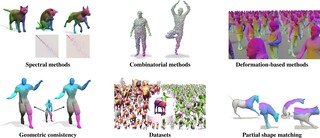
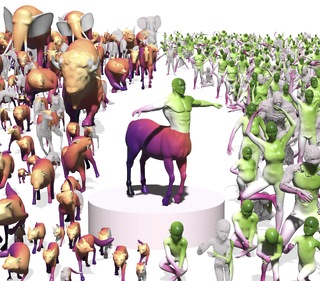
This state-of-the-art report surveys modern techniques for matching deformed 3D shapes, organizing the field into spectral methods based on functional maps, combinatorial formulations with discrete constraints, and deformation-based approaches for global alignment. We discuss emerging directions including zero-shot correspondence from vision foundation models and the open challenge of partial shape matching.
2025
NeurIPS
Copresheaf Topological Neural Networks: A Generalized Deep Learning Framework
Mustafa Hajij, Lennart Bastian, Sarah Osentoski, ..., Theodore Papamarkou, Tolga Birdal
Advances in Neural Information Processing Systems (NeurIPS), 2025
We introduce copresheaf topological neural networks (CTNNs), a powerful and unifying framework that encapsulates a wide spectrum of deep learning architectures, designed to operate on structured data. The framework aims to address challenges in representation learning by using concepts from algebraic topology.
ICCV (Oral)
Forecasting Continuous Non-Conservative Dynamical Systems in SO(3)
Lennart Bastian*, Mohammad Rashed*, Nassir Navab, Tolga Birdal
IEEE International Conference on Computer Vision (ICCV) - Oral (Top 2.6%) , 2025
We study rotational forecasting on the manifold SO(3). This leads to the proposed Savitzky-Golay Neural Controlled Differential Equations which learn continuous data-driven priors on the manifold and excel at extrapolating rotational states.
MedIA
Beyond Role-Based Surgical Domain Modeling
Tony Wang*, Lennart Bastian*, Tobias Czempiel, Christian Heiliger, Nassir Navab
Medical Image Analysis (MedIA) (Journal IF 10.7, rank among CV venues), 2025
We achieve generalizable re-identification and tracking for surgical operating rooms (OR). This enables our proposed staff-centric surgical domain models, the first concept for personalized intelligent systems in the OR.
SGP
Beyond Complete Shapes: A Quantitative Evaluation of 3D Shape Matching Algorithms
Viktoria Ehm, Nafie El Amrani, Yizheng Xie, Lennart Bastian, Maolin Gao, Weikang Wang, Lu Sang, Dongliang Cao, Zorah Lähner, Daniel Cremers, Florian Bernard
Symposium on Graphics Processing (SGP), 2025
We present BeCoS, the first comprehensive benchmark and evaluation framework for the challenging but widely applicable problem setting of partial shape correspondence.
Preprint
Mutual Information Free Topological Generalization Bounds via Stability
Mario Tuci, Lennart Bastian, Benjamin Dupuis, Nassir Navab, Tolga Birdal, Umut Simsekli
Preprint, 2025
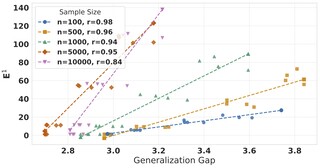
We develop a new theoretical framework using algorithmic stability and topological data analysis to establish generalization bounds without complex mutual information calculations.
COLAS (Oral)
Mitigating Biases in Surgical Operating Rooms with Geometry
Tony Danjun Wang, Tobias Czempiel, Nassir Navab, Lennart Bastian
MICCAI COLAS Workshop - Oral (top 16%) , 2025
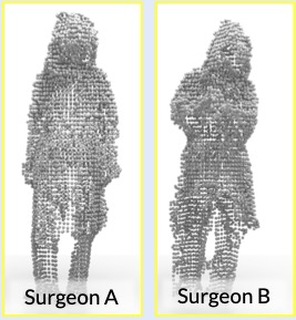
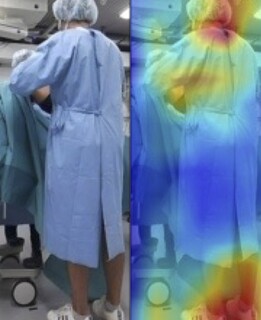
We show that 3D point cloud sequences capture robust biometric information for surgical personnel recognition, avoiding the appearance-based shortcuts that cause RGB models to fail in real clinical settings.
COLAS (Best Paper)
TrackOR: Towards Personalized Intelligent Operating Rooms Through Robust Tracking
Tony Danjun Wang, Tobias Czempiel, Nassir Navab, Lennart Bastian
MICCAI COLAS Workshop - Best Paper Award, 2025
We present TrackOR, a robust tracking framework for personalized intelligent operating rooms that enables consistent personnel identification across surgical procedures.
CVPRW
Continuous-Time SO(3) Forecasting with Savitzky-Golay Neural Controlled Differential Equations
Lennart Bastian, Mohammad Rashed, Nassir Navab, Tolga Birdal
CVPR 2025 Workshop on 4D Vision, 2025
We combine Neural Controlled Differential Equations with Savitzky-Golay path guidance to model continuous-time rotational dynamics on SO(3), achieving improved long-term forecasting of rotational motion.
2024
CVPR
Hybrid Functional Maps for Crease-Aware Non-Isometric Shape Matching
Lennart Bastian*, Yizheng Xie*, Nassir Navab, Zorah Lähner
IEEE Conference on Computer Vision and Pattern Recognition (CVPR), 2024
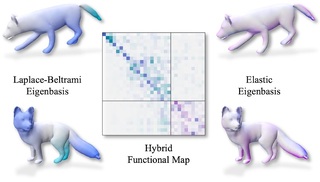
We propose a hybrid approach for estimating functional maps that leverage the strengths of basis functions originating from different operators overcoming limitations of previous approaches for non-isometric deformations.
2023
MICCAI
S3M: Scalable Statistical Shape Modeling through Unsupervised Correspondences
Lennart Bastian*, Alexander Baumann*, Emily Hoppe, Vincent Bürgin, Ha Young Kim, Mahdi Saleh, Benjamin Busam, Nassir Navab
Medical Image Computing and Computer Assisted Intervention (MICCAI), 2023
We propose an unsupervised method for statistical shape model (SSM) construction that utilizes functional correspondences to learn shape structures across population anatomies, demonstrating robustness to noisy and potentially scaling to larger patient populations without manual annotations.
MICCAI
SegmentOR: Obtaining Efficient Operating Room Semantics through Temporal Propagation
Lennart Bastian*, Daniel Derkacz-Bogner*, Tony D Wang, Benjamin Busam, Nassir Navab
Medical Image Computing and Computer Assisted Intervention (MICCAI), 2023
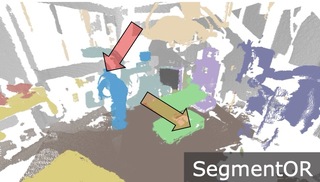
SegmentOR is a weakly-supervised 3D semantic segmentation method for operating room environments that leverages temporal consistency in 4D point cloud sequences to significantly reduce the annotation burden. We demonstrate the utility of the resulting segmentation maps for improving downstream surgical workflow analysis.
IPCAI
DisguisOR: Holistic Face Anonymization for the Operating Room
Lennart Bastian*, Tony Danjun Wang*, Tobias Czempiel, Benjamin Busam, Nassir Navab
International Journal of Computer Assisted Radiology and Surgery (IPCAI/IJCARS), 2023
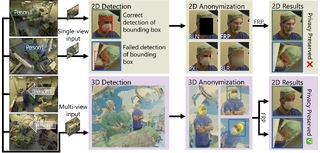
DisguisOR improves the robustness of operating room video anonymization by leveraging multi-view data to accurately localize and anonymize individuals’ faces in 3D, resulting in geometrically consistent privacy protection across all camera views.